
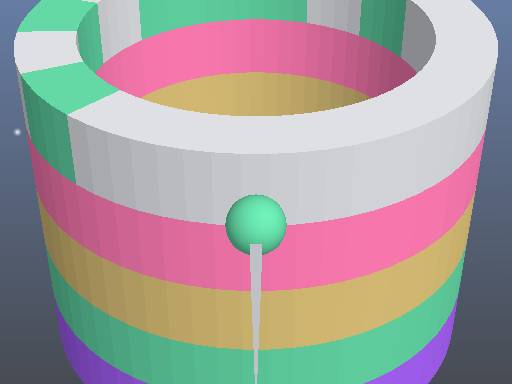
Hoop Paint Arcade Challenge
Review
Hoop Paint Arcade Challenge strips the arcade shooter down to a single tap and a timer. Its strength is clarity: you always know what to do, and failure comes from misreading the moving colored pieces rather than from unclear rules. The escalating ring counts and faster obstacles give it a reason to keep replaying. It is not a deep progression game, and players wanting unlocks or story will find it thin. As a quick, safe reflex challenge for all ages, it does its job without padding.
Full story
Tap-to-Shoot Core Loop
Hoop Paint Arcade Challenge is a hypercasual arcade title built around a single input: tap or click to send a ball toward a hoop. Each successful pass paints that ring. Clear every ring on a level to progress, but the route is rarely a straight line. Colored pieces drift across the screen and can intercept your shot, so you must read their movement before releasing. The whole loop lasts seconds per attempt, which suits short breaks and repeated runs.
Timed Levels and Escalation
Every level runs on a countdown. Miss the deadline and the attempt ends, which turns each shot into a small risk calculation. Early stages give you generous windows and few rings. Later stages add more hoops and speed up the moving blockers, shrinking the gap between a safe shot and a wasted one. Because the difficulty curve is tied to obstacle speed and ring count rather than new mechanics, improvement comes from sharper timing rather than memorizing new rules.
Reading Obstacle Patterns
The colored pieces are the real puzzle. They do not chase the ball, but their paths cross the shooting lane at predictable intervals. Watching a full cycle before tapping is often faster than firing immediately and losing the attempt. Players who track two or three moving pieces at once tend to clear rings with fewer wasted shots. This pattern-reading is what separates a lucky run from a consistent one.
Who It Suits
The game targets players who want a quick reflex challenge without tutorials or complex controls. Its bright, non-violent presentation makes it appropriate for family play, and the short level structure works for commutes or waiting rooms. Anyone expecting deep progression systems or narrative should look elsewhere; the appeal here is the repeated attempt, the near-miss, and the clean run.
Compatibility
FAQ
Reader Comments
Sign in to comment
You must be logged in before posting a review or rating.
No comments yet. Be the first to comment!



Editorial Notes