
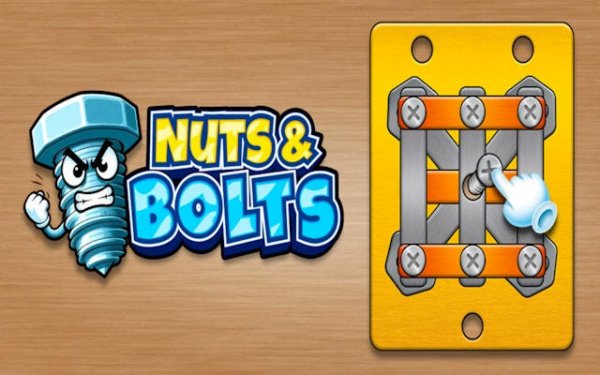
Nuts & Bolts Puzzle Challenge
Review
Nuts & Bolts Puzzle Challenge is a casual puzzle game built around disassembly logic. Its strength lies in the no-timer design, which lets players analyze each mechanism without pressure. The progressive difficulty and pattern-recognition element give it lasting appeal for fans of brain teasers. The main limitation is the lack of variety beyond the core mechanic, but for players who enjoy methodical problem-solving, it offers a satisfying mental workout.
Full story
Understanding the Disassembly Goal
Each level in Nuts & Bolts Puzzle Challenge presents a mechanical assembly held together by bolts, nuts, and pins. Your objective is to remove these fasteners in the correct order to free a primary bolt or guide it through obstacles. The layout varies per level, so you must examine how components connect before acting. Tapping pins and dragging bolts are the core interactions, and the sequence matters because a wrong removal can lock the puzzle, forcing a restart.
Planning Each Move
The game rewards analysis over speed. Before touching anything, study which pins are critical to the structure and which can be removed safely. Removing a supporting pin too early may trap the main bolt. Feedback on correct actions helps you learn from mistakes, and with practice you begin recognizing patterns across different arrangements. Since there are no time limits, you can think through each step at your own pace.
Progression and Challenge Curve
Nuts & Bolts Puzzle Challenge starts with simple configurations and gradually introduces more complex assemblies. This gentle learning curve keeps the experience approachable while still offering a mental workout. New levels present different arrangements, maintaining variety without overwhelming you. The difficulty comes from the logic of the mechanism, not from artificial pressure.
Visuals and Controls
Clean, clear visuals make each component easy to identify, which is essential when you need to track how parts interact. The intuitive physics respond naturally to your actions, so the outcome of a move feels predictable once you understand the structure. Simple controls—tap and drag—mean you can focus on solving rather than fighting the interface.
Compatibility
FAQ
Reader Comments
Sign in to comment
You must be logged in before posting a review or rating.
No comments yet. Be the first to comment!




Editorial Notes